





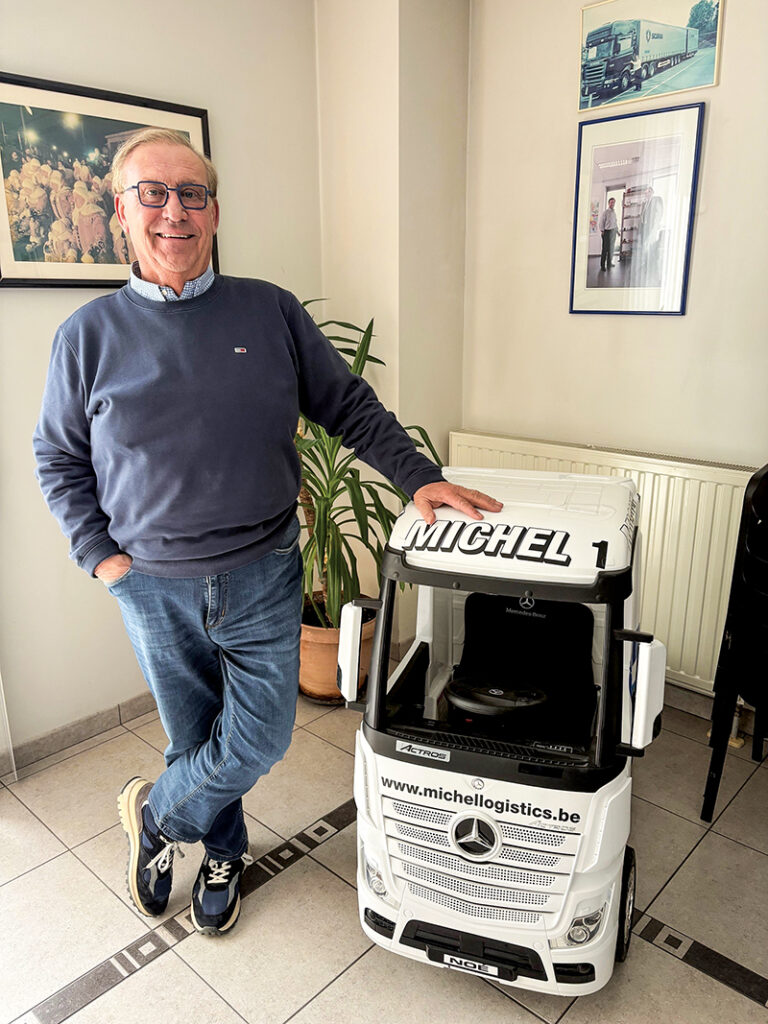
Didier Michel, president of Transfrigoroute International (TI), and Dirk Saile, the organization’s secretary general, discussed in an interview with Tranzit Magazine the transformations in European refrigerated transport, the legislative pressures reshaping the industry, and the need to rebuild strong European representation for this sector. Romania could once again play an important role.
Refrigerated transport is one of the most sensitive segments of European logistics. Food, pharmaceuticals, flowers, and medical products travel daily on European roads under strict temperature conditions, and any interruption in the cold chain can result in major losses.
“Refrigerated transport is different from any other type of transport,” says Didier Michel. “We don’t transport goods that you can leave in a parking lot for two days. We transport perishable products that must be delivered on time and under precise temperature conditions.”
According to industry estimates, refrigerated transport accounts for approximately 10–15% of the total road freight market in Europe, a percentage that has remained relatively stable in recent years. “We’re seeing the same trend as in other sectors: companies are consolidating and becoming stronger,” explains Saile.
European policies reshaping the refrigerated transport industry
Refrigerated transport is currently at the center of major transformations driven by European climate policies.
“Our sector is at the intersection of two revolutions,” notes a report by Transfrigoroute International for the UN Economic Commission for Europe. “On the one hand, the decarbonization of transport, and on the other, the transformation of refrigerants used in refrigeration equipment to make them more sustainable.”
These changes pose specific challenges for refrigerated transport. The vehicles are heavier than those used in general transport because they include refrigeration units and insulation systems.
“Our trucks are already heavier by their very nature,” explains Dirk Saile. “If we add batteries or other technologies for decarbonization, the problem becomes even more complex.”
For this reason, Transfrigoroute is seeking to influence European discussions on vehicle weights and dimensions so that the specific characteristics of refrigerated transport are taken into account.
The F-Gas Regulation and the Future of Refrigerants
Another major issue is the European F-Gas Regulation, which introduces stricter targets for reducing greenhouse gas emissions.
The new rules adopted in 2024 introduce stricter targets for reducing the use of these greenhouse gases and extend certification requirements to the refrigerated transport sector, accelerating the transition to natural refrigerants or other alternative technologies.
“The direction is clear,” says Saile. “We need to phase out F-gases, but not immediately. The industry needs time to develop viable alternatives.”

Electrification of Truck Parking Lots
Another issue Transfrigoroute has been involved in at the European level is the electrification of truck parking lots. The organization has asked the European Commission to ensure that new certified parking lots are equipped with outlets to power trailer refrigeration units.
Currently, most refrigeration units can operate on electricity when the vehicle is parked, but the necessary infrastructure is insufficient. According to TI, using electricity instead of diesel for refrigeration units could reduce CO₂ emissions by nearly 70%.
The Daily Challenges Facing Temperature-Controlled Carriers
Beyond European regulations, refrigerated carriers face the same problems as the entire transport industry: a shortage of drivers, a lack of secure parking, rising energy costs, and bureaucracy.
“If a truck carrying food gets stuck, the losses are much greater than with other goods,” says Didier Michel.
“We don’t transport goods that can wait in a parking lot,” explains Saile. “We transport perishable goods. The cold chain must operate 365 days a year.”
This operational pressure exacerbates the staffing crisis and infrastructure issues.
In Belgium, for example, the driver shortage is estimated at around 6,000, and the situation is similar in many other European countries. According to IRU estimation, by 2030 more than 500.000 drivers will be missing.
An organization with 70 years of history
For over seven decades, temperature-controlled road transport has been represented at the European level by Transfrigoroute International (TI). Founded in 1955, the non-profit organization has, since its inception, registered approximately 1,700 members and 25 national associations active in temperature-controlled road transport and cold chain logistics.
“Our role is to improve cold chain logistics and represent the sector’s interests before European authorities,” explains Didier Michel.
Transfrigoroute International brings together carriers, refrigeration equipment manufacturers, vehicle manufacturers, service providers, and technical organizations in the temperature-controlled transport sector.
The organization’s work is divided between political representation and the technical development of the sector. TI participates in European legislative consultations, collaborates with institutions such as the European Commission or UNECE, as well as with international organizations such as the IRU or the International Institute of Refrigeration.
The organization also includes important technical bodies. A central role is played by the Technical Committee (CCT), which analyzes technological developments in the field of refrigerated transport and participates in discussions regarding industry standards and regulations.
“The CCT is where industry experts discuss technical issues—from refrigerants to vehicle standards,” explains Didier Michel.
At the same time, FrigoClub offers carriers a platform for collaboration and the exchange of experiences, including for operational partnerships. “We need to be relevant to companies and offer them a platform where they can discuss the industry’s real issues and influence policy decisions,” stated Dirk Saile.
The Role of National Transfrigoroute Organizations
The Transfrigoroute structure is based on national organizations that represent the sector at the local level and contribute to European activities. Currently, the most active organizations in the TI network are those in Germany, France, Belgium, the Netherlands, Italy, and Spain, which represent a significant portion of the European refrigerated transport market.
One example is Transfrigoroute Deutschland, one of the most active organizations in the network, which functions as a center of expertise for food logistics and refrigerated transport. It collaborates with authorities and industry to develop technical standards, adapt legislation, and promote innovation in refrigerated transport.
In France, Transfrigoroute collaborates with institutions such as CEMAFROID and national authorities to develop best-practice guidelines for food transport and to implement technical standards in the field.
In the past, the TI network was much more extensive and included countries in Eastern Europe. Romania, the Czech Republic, Slovakia, and Croatia were members, but participation has declined in recent years.
“For me, one of the challenges of this term is to bring Eastern European countries back into the organization,” says Didier Michel. “Europe must be represented in its entirety.”
Message for Romanian carriers
For Transfrigoroute leaders, expanding the organization into Eastern Europe is essential.
“My message to Romanian carriers is simple: become part of the family,” says Dirk Saile.
Membership in TI means more than just political representation at the European level. In practice, it offers information sharing and access to a community of European carriers who can support one another at the operational level.
“If a German company has a problem in France or another country, it can call a colleague in the network. It’s a professional community,” explains Saile.
Didier Michel is convinced that the sector’s future depends on this European cooperation. “Refrigerated transport is a strategic sector, and to defend it we need a strong European voice,” he says. “And this voice must also include Eastern Europe.”
In the coming months, Transfrigoroute International is planning new meetings with members of the European Parliament and the European Commission to discuss the industry’s key legislative issues.
And for Romanian carriers, the invitation is open.
“We look forward to seeing you in Brussels,” says Michel. “Let’s discuss the future of European refrigerated transport together.”
Frigoexpres – a pioneer in private refrigerated transport in Romania
Founded in 1993, Frigoexpres was the first privately owned international transport company for perishable goods in Romania, at a time when the refrigerated transport sector was still in its early stagesfollowing the economic transition.
The company played a key role in integrating Romanian carriers into European professional networks. Frigoexpres has represented Romanian temperature-controlled carriers within Transfrigoroute International for over 25 years, serving as an active member of the organization, including in the leadership structures of Transfrigoroute International in Brussels.
Through this involvement, Frigoexpres has helped connect the Romanian refrigerated transport industry to the European community of operators specialized in the logistics of perishable goods.